This is the testing/development version of the Koch Institute website.

News

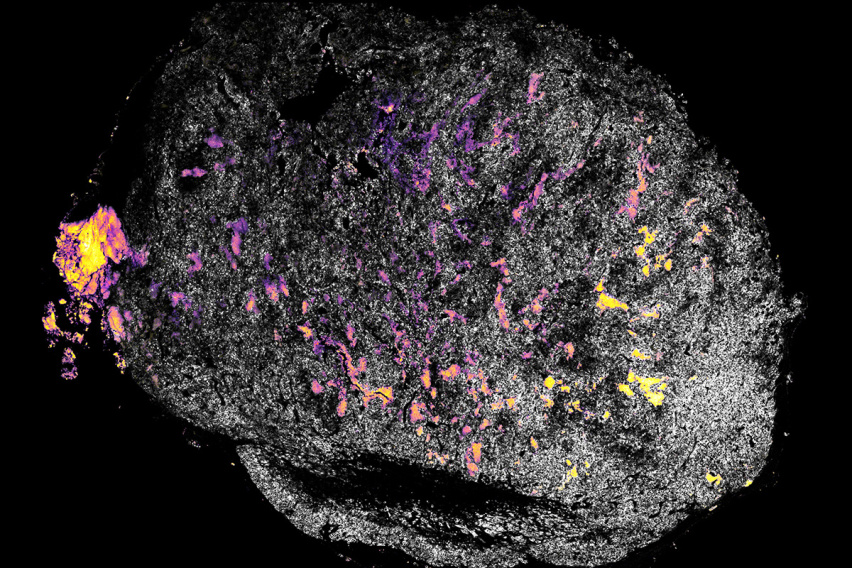
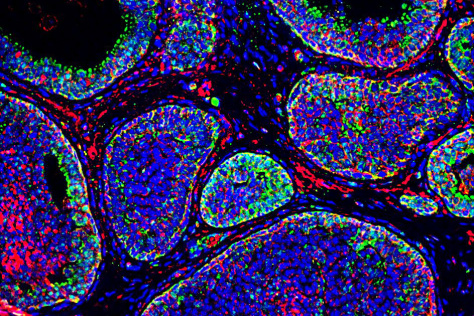
a tumor imaged after treatment, stained pink for IL12 and yellow for alum

Alum for the Ride

MIT News

Irvine and Wittrup lab researchers have developed a technique to make cytokine therapy less toxic. These immunostimulatory molecules are quite potent and can have devastating side effects if administered systemically. In a preclinical study appearing in Nature Biomedical Engineering and supported in part by the Marble Center for Cancer Nanomedicine, the researchers anchored the cytokines to tumors with aluminum hydroxide, a compound that is often used to make vaccines more effective. They then administered immune checkpoint blockade therapy, observing that the tumors were eliminated in 50 to 90 percent of the mice across three cancer types. The technology has been licensed to a startup company that hopes to begin clinical trials by the end of the year.

Filter by

Filter by Title/Description

Filter by Topic

Filter by Year

Alpaca Punch

MIT News

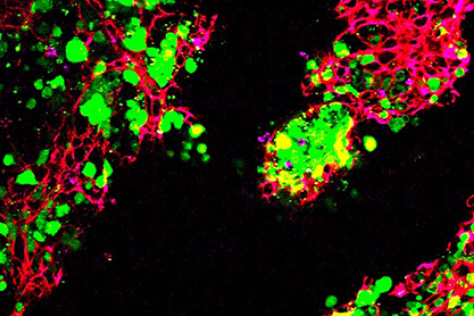
In two studies appearing in Proceedings of the National Academy of Sciences, researchers from the laboratory of Richard Hynes, KI member and Daniel K. Ludwig Professor for Cancer Research, showed how tumors and metastases could be imaged and treated with lightweight antibodies (or, "nanobodies") derived from alpacas. The nanobodies target the extracellular matrix (ECM), which plays important roles in cancer cell survival, invasion, and development, and is more genetically stable, less heterogenous, and easier to access than cancer cells.

The researchers, led by Mazumdar-Shaw International Oncology Fellow Noor Jailkhani, built a nanobody library for ECM proteins that were abundant in the tumor microenvironment, but absent from healthy tissues. In one study, researchers treated mouse cancer models with radioisotope-labled nanobodies. PET/CT imaging revealed clearly visible tumors and metastases. In the companion study, they used the same nanobodies to develop nanobody-based chimeric antigen receptor (CAR) T cells to target solid tumors.

"And the Academy and awards go to..."

MIT Koch Institute

...Paula Hammond, Ed Boyden, and Aviv Regev, for their election to the National Academy of Sciences. Hammond, David H. Koch Professor in Engineering and head of MIT's Department of Chemical Engineering, is being honored for her work in nanomedicine, using biomaterials to enable targeted drug delivery and self-assembled materials systems for electrochemical energy devices. Boyden, Y. Eva Tan Professor in Neurotechnology, develops new tools for probing, analyzing, and engineering brain circuits. Regev, Professor of Biology, studies the molecular circuitry that governs the function of mammalian cells in health and disease.

...Robert Langer, the David H. Koch Institute Professor, for the 2019 Dreyfus Prize in the Chemical Sciences, awarded by The Camille and Henry Dreyfus Foundation "for discoveries and inventions of materials for drug delivery systems and tissue engineering that have had a transformative impact on human health through chemistry." This prestigious prize in chemistry and related fields was focused this year on advances that have benefited human health. Notably, Langer is the first chemical engineer to receive it.

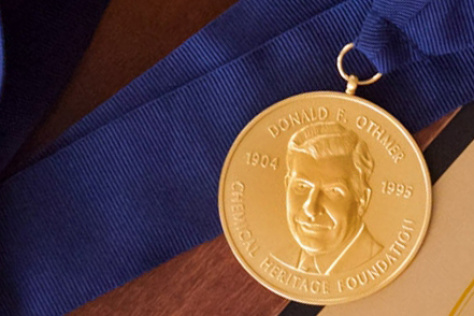
...Sangeeta Bhatia, the John J. and Dorothy Wilson Professor of Health Sciences and Technology and of Electrical Engineering and Computer Science, for winning the 2019 Othmer Gold Medal from the Science History Institute for adapting technologies developed in the computer industry for medical innovation and for advocacy for diversity in science and engineering.

...Angela Koehler, the Goldblith Career Development Professor in Applied Biology, for receipt of the NSF CAREER Award. The award will support her work designing and synthesizing new chemical compounds that can change the "master program" that turns genes on and off in a cell. Koehler also won the MIT School of Engineering's 2019 Junior Bose Award for Teaching Excellence.

...Regina Barzilay, the Delta Electronics Professor, for making the "Top 100 AI Leaders in Drug Discovery and Advanced Healthcare" compiled by Deep Knowledge Analytics.


Row, Row, Row Your Bot

MIT News

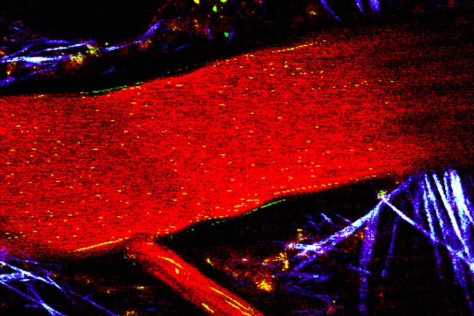
Microrobots developed by Bhatia Lab researchers swim through the bloodstream with a payload of nanoparticles in their wake. Inspired by the flagella of bacteria, researchers equipped microbots with helical propellers and placed them in a fluidic model designed to simulate disease-like environments. When an external magnet is applied, the micropropellers rotate, generating flow disruptions that drag nanoparticles along with them. Researchers also conscripted the iron oxide-producing bacteria Magnetospirillum magneticum to generate the wake. Their findings, described in Science Advances, could help overcome the challenge of moving drug-carrying nanoparticles out of blood vessels and into tumors or other target tissues. 

What's On Your Plate?

eLife

Cancer cell metabolism—as well as tumor growth and drug sensitivity—is profoundly influenced by the nutrient profile of the surrounding microenvironment. However, according to new research from the laboratory of KI member Matthew Vander Heiden, the nutrient composition of tumor interstitial fluid is significantly different from the plasma that feeds normal cells. Research in mice also shows variation based on diet and tumor location and site of origin. The findings, published in eLife with former KI postdoc Alex Muir as co-senior author, suggest that model cancer cells grown in media that more closely replicate physiological nutrient levels might better predict which genes are essential to tumor metabolism. The research was funded in part by the MIT Center for Precision Cancer Medicine and the Ludwig Center for Molecular Oncology. 

New Images in Bloom

MIT Koch Institute

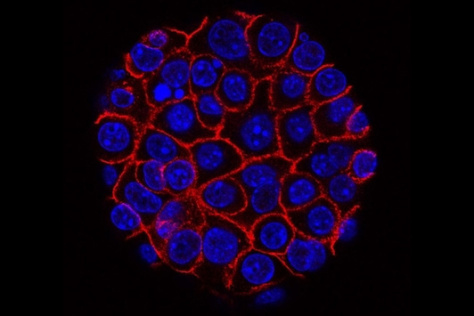
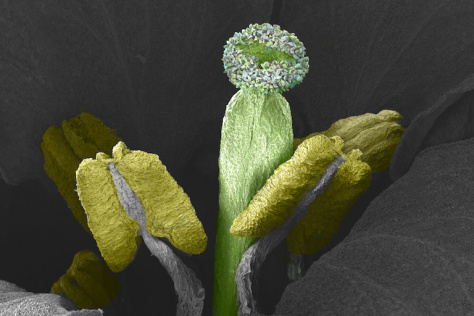
On the first day of spring, the 2019 Koch Institute Image Award winners unveiled the latest visuals to grace the lightboxes in the Koch Institute Public Galleries. Featuring a range of topics from developmental biology to machine learning, the ninth annual exhibition celebrates the diversity of MIT's biomedical research and the many fields that contribute to our understanding of cancer and the fight against it. View the images in Cell Picture Show, see photos and presentations from the opening event, or read more in STAT.

In Like a Lion

MIT Koch Institute

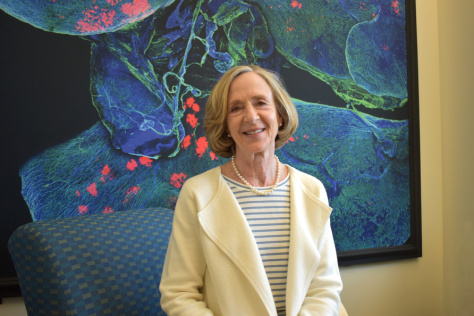
This spring, KI faculty member Susan Hockfield continues to champion causes for which she has a long-standing passion—the convergence of the life, physical, and engineering sciences, the advancement of women in the sciences, and support and funding for the research community.

Hockfield has penned a new book on convergence, The Age of Living Machines, which she will discuss with NPR and WBUR host Robin Young at a KI public event on May 16. 

Last month, Hockfield spoke at the American Museum of Natural History in New York City, at the launch of the Lyda Hill Foundation’s IF/THEN initiative to inspire girls to consider STEM careers.

Hockfield also received the Geoffrey Beene Foundation Builders of Science Award, one of Research!America’s 2019 Advocacy Awards recognizing individuals who advance research and public health to benefit individuals worldwide.

But what he really wants to do is direct...

MIT Koch Institute

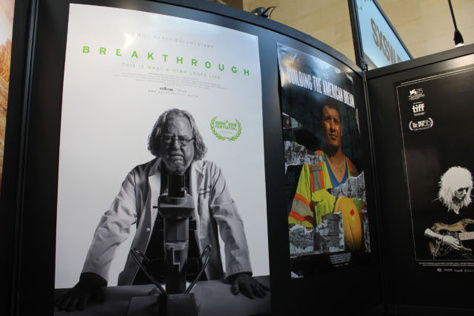
Tyler Jacks, cancer researcher, mouse model pioneer and now...movie star? Jacks lends his voice and reflections to Breakthrough, a brand new documentary about 2018 Nobel Prize winner (and 2019 KI Summer Symposium keynote speaker) Jim Allison. Fresh off its SXSW premiere showing and follow-on screening at the AACR annual meeting, the documentary hits MIT this coming June. Stay tuned for details, and in the meantime, read more in The Washington Post and The Daily Mail.

A Tale of Two Acidities

MIT News

Scientists have long understood that an acidic microenvironment is associated with more aggressive cancer cells, and have attributed tumors' higher acidity to its oxygen-deprived interior. However, a study led by KI faculty member Frank Gertler mapped acidic regions to the tumor surface as well as to its interior. In a paper appearing in Cancer Research, researchers also showed that acidic cells ramped up production of proteins that promote invasion and metastasis and that this process could be reversed in mice by making the tumor environment less acidic. 

Amon to Co-Direct Alana Down Syndrome Center

MIT News

KI faculty member Angelika Amon will co-direct the new Alana Down Syndrome Center, which will be established at MIT's Picower Institute for Learning and Memory with a $28.6 million gift from the Alana Foundation. Amon's lab will bring its expertise in aneuploidy and chromosomal instability in cancer to the study of Down Syndrome, a condition characterized by extra genetic material from some or all of chromosome 21. 

The Building Blocks of Creative Chemistry

Chemical & Engineering News

A Chemical & Engineering News profile of David H. Koch Professor of Engineering Paula Hammond traces her passion for chemical engineering, from her early fascination in high school with the creative potential of chemistry to her current work here at the Koch Institute. Hammond harnesses electrostatic properties of materials to build nanoparticles that address a vast array of engineering problems, from storing electochemical energy to timing and targeting the delivery of cancer drugs.

Of course, as a longtime mentor to students and, currently, the head of MIT's Department of Chemical Engineering, Hammond's recognition of the power of multiple perspectives is not limited to the nanoscale. "Excellence is gained from diversity," she says, which helps us "make inroads into difficult problems because we put together people who have different ways in which they approach problems."